

Large Language models (LLMs) have taken the world by storm ever since OpenAI launched ChatGPT in November 2022. Nearly four years later, it’s safe to say that we still have not adjusted to the change AI brought in an educational environment.
LLMs are typically used for anything that falls under content generation. One prompts it by asking it a question, and it creates an algorithmic based response to complete your answer almost immediately through a process called probabilistic tokenization.
Since 2022, LLM usage has skyrocketed, being promoted everywhere and put into nearly every app and company imaginable. Looking at the US economy, the leading AI companies (NVIDIA, Amazon, Microsoft, OpenAI, AMD, Anthropic, and Meta, just to name a few) keep shuffling around large sums of money to each other in “investment” towards new products and increased server supply, keeping their stocks high.
AI goes far beyond LLMs. Grammarly, auto-correct, self-driving cars, Snapchat’s “MyAI” (well, this is an LLM), TikTok’s For You page, are all examples of “AI” you’ve probably used or seen around you. The latest buzzword, or innovation, “Agents”, lets AI do specific tasks like order products directly in online stores like Shopify and Amazon or create playlists in Spotify through unique access to these services.
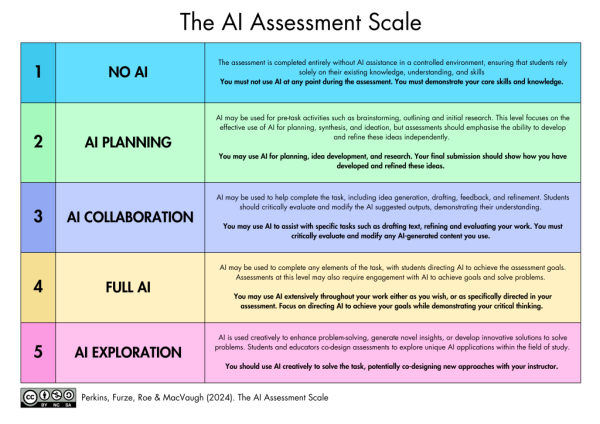
AI and LLMs bring growing issues. To combat this, LMUSD recently adapted Leon Furze’s AI Assessment Scale for use at AGHS, which allows teachers to determine how AI is used in the classroom from “No AI use, to brainstorming and ideas all the way to full feedback and complete cooperative workflows,” ranked on a 5-point scale.
It’s important to note that this scale is, by design, a framework for schools and businesses to adapt rather than a sole solution. It’s a great beginning in addressing the problems of AI.
Gathering data through a simple 6-question Google Form posted to my Instagram left me with a rough idea on local sentiment that mirrors the general response to AI.
There was a 30%-50% split between liking AI and disliking it, and the rest were uncertain as to where they stood. Meanwhile, nearly every surveyor disapproved of AI video generation tools and platforms, such as OpenAI’s Sora or Google’s VEO.
Beyond anything, AI is most disapproved of within the arts and entertainment. Disney, to much surprise, recently allowed OpenAI to use their copyrighted characters in video creation in a multi-billion dollar deal.
With education, there was a shift. Most people suggested that they would approve of AI within education, with slightly more supporting it as a student-led study tool rather than it being used in the hands of their educators.
When asked, “Do you have any thoughts on the last few questions?” from my survey, a student said: “AI is ruining our ability to think critically and do things for [ourselves]. I am genuinely baffled by how many people I know cannot write their own emails or make their own decisions without using AI.”
Another individual wrote: “The axe that cuts wood may also cut skin and bone, and AI is that axe.”
While the tools are useful, the path we take with said tools can cause harm.
Some students find value in AI for asking difficult questions, or questions they wouldn’t feel comfortable asking an adult.
It is necessary to note that these language models are not professionals, and you should not rely on their advice when it comes to medication or other significant decisions affecting your health and well-being.
AI companies are attempting to court students and teachers alike with glamorous education discounts/packages. All leading AI companies, barring Anthropic and Elon’s xAI, offer student discounts for college aged students using their school provided email.
With concern towards time management, and the ease of access of LLMs, it is essential to acknowledge and adapt to the systems around us.