

For decades, the Blue Zoo has been the heartbeat of Arroyo Grande High School (AGHS), but the pulse hasn’t always stayed the same. According to Leadership Teacher Shannon Hurtado, AGHS alumna (‘88) and AGHS’s Activities Director since 2006, the definition of being an Eagle has shifted from small, sports-centric club to a massive, campus-wide culture of inclusivity.
When Hurtado walked these halls as a student from 1984-88, school spirit was a niche operation.
“We only had one leadership class; it was ASB,” Hurtado said. “It was approximately a dozen students.”
With such a small team back in the ‘80s and ‘90s the main focus of ASB was on football and basketball, along with some rallies and an occasional lunchtime activity.
Today that “dozen” has exploded into a leadership powerhouse of nearly 100 students across ASB, Link Crew (started in 2000), and Academic Improvement Motivation (AIM) (started in 2015). With this intense growth, Hurtado realized that school pride couldn’t just be directed towards athletes.
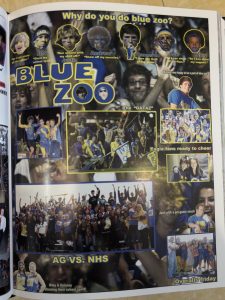
“What about the band? Well, what are you doing for the drama kids? What about the smart kids?” Hurtado said. “You really need to look beyond [athletics] and make sure a variety of groups on our campus are being celebrated.”
Before the era of smartphones, spreading school pride was a manual labor of love involving posters, sidewalk chalk, and the morning bulletin that teachers read out loud.
The introduction of social media changed the Leadership game, creating a double-edged sword for student participation. While platforms like Instagram help create “FOMO” (fear of missing out) for big events, they have also made students more hesitant to participate in daily spirit days. Hurtado observed that students are often afraid to go “all out” if they aren’t sure everyone else is doing it.
“If we did Crazy Hair Day and you show up and you’re the only one sitting in your class, then it gets embarrassing for them,” Hurtado said. “You have to build trust all year long so that when you get to Greek Week, you feel like, ‘Okay, now I’m going to go all out.’”
To combat this, she has shifted to “low threat” dress-up days, like Pinkalicious, or Jersey Day.
The most significant hindrance to school spirit was students’ return to in-person learning after Covid-19. Hurtado described a sense of “malaise” or apathy that really settled over the campus. Students had lost the tradition of watching older classes set the tone for participation and excitement.
“There was a lack of experience; when you have students who had not been in a leadership program, [that] didn’t know how to run a rally, [they] may not have even seen a rally,” Hurtado said.
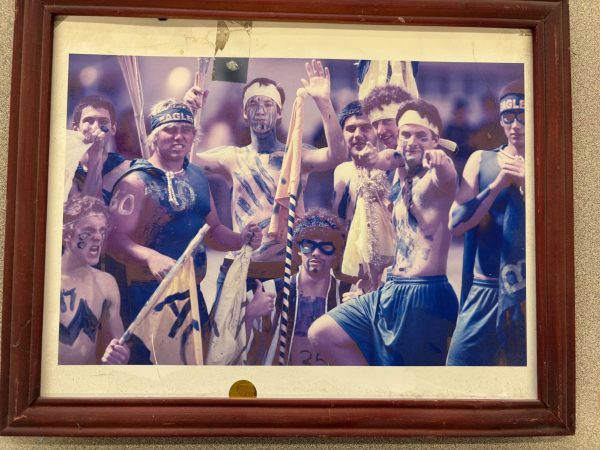
Furthermore, the fear of being recorded on a cell phone and looking like a “ding-a-ling” has dampened the spontaneous, high energy traditions of the past– like the “gataz,” a group of boys who used to paint their bodies and run the track during games.
Despite the challenges of the digital age, Hurtado remains focused on the bigger picture of what it means to be an Eagle. To her, spirit isn’t just a chant; it’s being proud of the school’s state-of-the-art Clark Center, the nationally-ranked drama department and having more Career Technical Education (CTE) programs than any other school on the Central Coast.
“I don’t look at school spirit just as wearing Blue Zoo [colors] on a Friday and being like ‘rah,rah,’” Hurtado said. “It’s more about an attitude of being proud to go to a high school.”
As AGHS continues to adapt, stealing the best ideas from other schools like Boat Regatta and making them uniquely “AG,” the goal remains the same: make sure every student feels like they belong in the nest.