

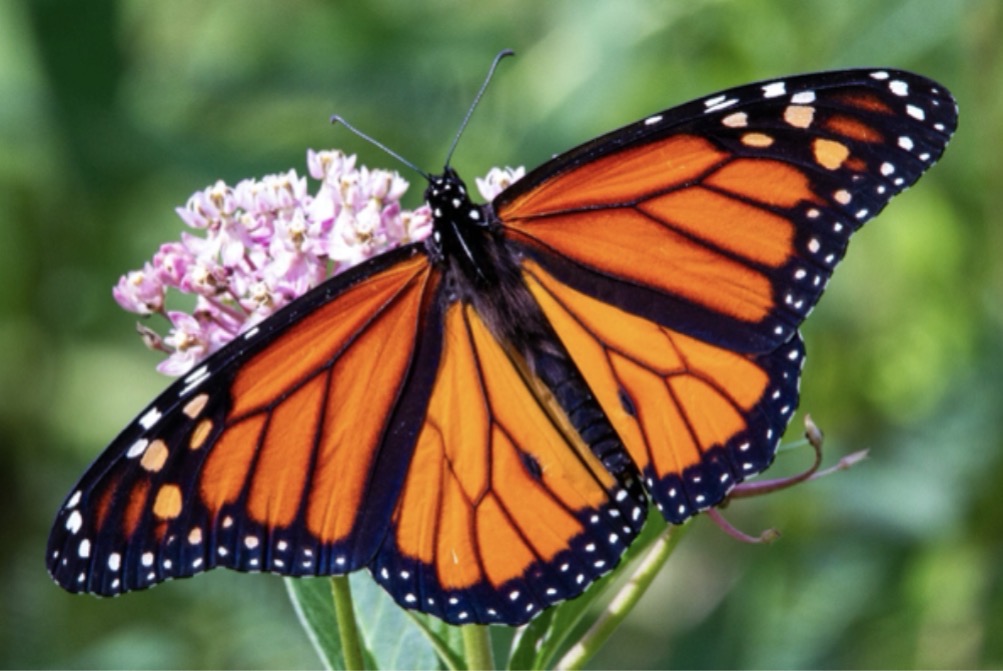
It’s a quiet winter morning at the Pismo Beach Monarch Butterfly Grove, and hundreds of monarch butterflies cling to the branches of eucalyptus trees. They hang motionless in dense clusters, waiting for the rising sun to warm the air. When it finally does, the grove comes to life. The clusters break apart, filling the skies with orange and black, a sight that has never failed to amaze generations.
Monarch butterflies are uniquely equipped for this journey. They weigh less than half the size of a paper clip and migrate hundreds of miles along the west coast. Most generations only live four to six weeks, but the generation that migrates can live up to nine months because they age at a slower rate, allowing them to conserve energy. Natalie Johntson, an education manager at the Pacific Grove Museum of Natural History, compares this lifespan to, “a human living to be over 300 years old.”
Monarch butterflies may look delicate, but they accomplish something massive. Every fall, they migrate from Canada and the Northern United States to Southern California and Mexico, a trip of hundreds of miles. Relying on only narrow stretches of land as habitat.
“Monarch butterflies are a type of pollinator. Pollinators are responsible for transferring pollen, which makes plants more genetically diverse, healthier, and more resilient against environmental changes and pests,” Johnston said.
Pollinators are essential to life on Earth. According to Johnston, between 70 and 90 percent of all plants are flowering plants, including at least seven out of ten crops that humans need.
“A world without pollinators is a world without flowers, and it’s also not a world that we can survive in,” Johnston said.
While bees are often regarded as the champions of pollination, monarchs play a pivotal role. Unlike many insects, Monarchs gather in dense clusters for long periods of time. This allows scientists to more accurately track populations. Something that is not possible with many other pollinators.
“Because monarch butterflies do this, we can count them. We can track their population in a way that you simply cannot do with other insects. By studying monarch butterflies, we are understanding how pollinators as a whole are doing,” Johnston said.
That data, however, is telling a troubling story.
According to Sara Cuadra-Vargas, a conservation biologist and monarch overwintering specialist with the Xerces Society for Invertebrate Conservation, Western Monarch populations have declined drastically.
“Only four decades ago, millions of western monarchs overwintered along the Pacific Coast. Unfortunately, the population has declined more than 95% since the 1980s,” said Cuadra-Vargas.
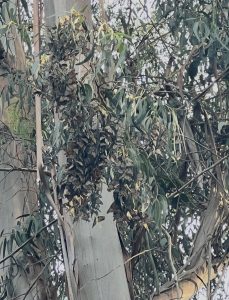
The Western Monarch Count, a community science program that began in 1997, documented this decline. That year, there were 1.2 million butterflies counted in California. In 2020, that number dropped below 2,000.
“For every 1,000 Monarch Butterflies that used to exist in 1997, only one exists today,” Johnston said.
The central coast has become increasingly more important as Monarch numbers shrink.
“Even in extremely low population years, like the 2024–2025 overwintering season when only 9,119 monarchs were found, sites in Santa Cruz have hosted the largest number of butterflies in the state. With [the] Pismo Beach Monarch Butterfly Grove in San Luis Obispo County also hosting hundreds of monarch butterflies,” said Cuadra-Vargas.
That concentration makes local habitats extremely important.
“The primary threats to Western Monarchs are climate change, pesticide use, and loss of breeding and overwintering habitat due to development,”Cuadra-Vargas said.
Climate change affects Monarchs in multiple ways, with the most significant being rising temperatures, long droughts, and extreme heat. All of which affects the only food source for caterpillars to eat.
“In the summer of 2024, there were record-breaking heat waves in Oregon and Washington. By the time that ended, there was no milkweed left for them, and the population just crashed,” Johnston said.
Pesticides are another major threat. Cuadra-Vargas pointed to a January 2024 incident in Pacific Grove where about 200 monarchs died after being exposed to different pesticides.
“There’s this unfortunate reality where plants are labeled ‘pollinator-friendly’, but they’ve been sprayed with pesticides. They’re willing to poison the very animal that the plant is trying to attract,”Johnston said.
Habitat loss is also compounding this problem.
“Western Monarchs need overwintering sites in Coastal California and Coastal California is prime real estate [for people],” Johnston said.
Despite the alarming trends and record low populations, both professionals emphasized the same positive sentiment.
“The monarch population can be bouncy. Numbers could shift from year to year due to environmental factors. The subsequent low population years, however, point to a serious need for action,” Cuadra-Vargas said.
One example is happening locally, between the California State Parks and Xerces Society at the Pismo State Beach Monarch Butterfly Grove.
“Together, they have worked to improve the butterfly grove by adding native trees, adding nectar plants to sustain monarchs in the winter, increasing monitoring efforts, and increasing public engagement,” Cuadra-Vargas said. “By protecting and enhancing overwintering groves, we make sure monarchs have a place to stay for protection in the winter months.”
Local action is really important because the trend can change fast.
“They’re insects. When given the chance, they bounce back pretty quickly,” Johnston said.
That recovery was seen post 2020 when monarch numbers rebounded dramatically following better conditions.
“That beautiful comeback really tells me that when given the chance, monarch butterflies can recover,” Johnston said.
For residents here in the five cities area, it’s not just about protecting a population but also a shared experience.
“Nowhere else on Earth can you find butterflies that come together in these dense groups that just hang on trees in these gorgeous clusters. When those clusters burst into the air at once, it’s one of the most beautiful sights to behold,” Johnston said.

Both experts expressed that individual contributions can make a difference. Planting native plants and milkweed, avoiding pesticides, and participating in community service programs can all make the biggest difference.
“You can also contact your elected officials and ask that monarch overwintering sites in your area [be] protected,” Cuadra-Vargas said
The flipside of that coin, however, is if nothing is done to help preserve the species.
“If no action is taken to help out the Western Monarch Butterfly, then it will go extinct by 2080. But when people act, they come back,” Johnston said.
For such a small insect, they have enormous meaning. Not just for the ecosystem, but also for the communities that share the love for the amazing bug.
“Monarch butterflies are connected to the entire habitat, and those habitats are connected to us,” Johnston said
Protecting them means also protecting places like the Monarch Butterfly Grove in Pismo Beach, so that generations can look up and watch the sky be filled with orange as these amazing creatures fly.