

Monday, Jan. 26, 8:56 a.m., a glowing, green button with a bell emblem, a two story building with a large garage and glass opening doors– Station 1 of the Five Cities Fire Authority (FCFA). FCFA was officially founded in 2010 when the cities of Arroyo Grande (AG), Grover Beach, and Oceano consolidated into one complete and efficient department (FCFA.org). FCFA oversees two stations; one near the Village in AG and the other in Grover Beach.
Three men behind the building’s glass front door offer welcoming smiles and gesture to say, “come in.” Hands extend to shake firmly and begin introductions– Fire Engineer Joe Rawson, Captain Burl Vreeland, and Battalion Chief and Fire Investigator Craig Angello.
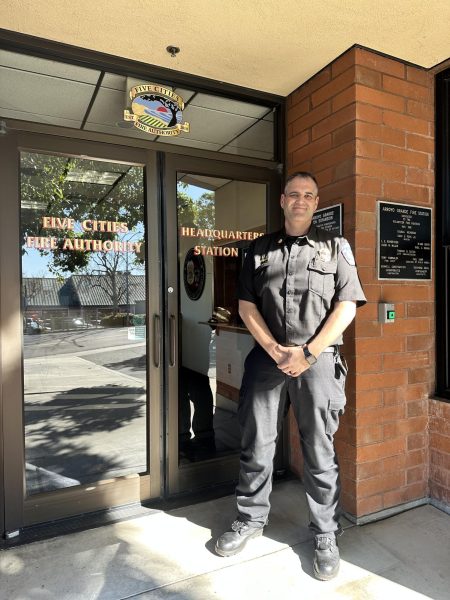
The men have been with FCFA full-time since 2019, 2018, and 2010, respectively. However, all three had previous experience in the blue-collar world before settling with their current positions at FCFA. Many of whom are second or even third generation firefighters.
A Look Inside
The tour of Station 1 began in the front office where Fire Captain Tom Hughey was working on a computer. Sharing the same manners of every man at the station, he excused himself from his work to offer his hand for a warm greeting.
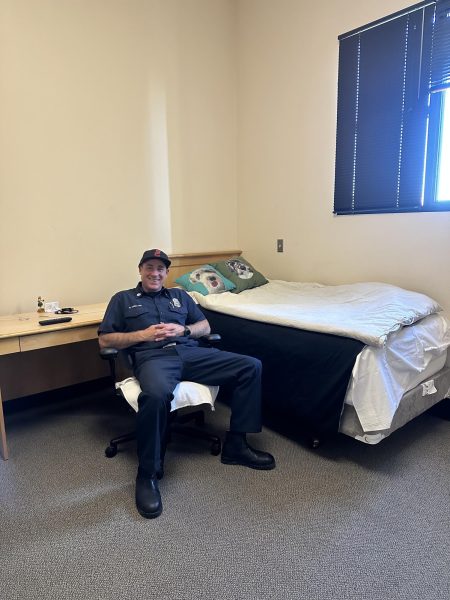
After a quick introduction, the tour continued into the Day Room, which held a calmer and lived-in feeling than the rest of the building.
The room was equipped with gray carpet, black leather reclining chairs and a television mounted to the wall. Extending past the carpet barrier was a kitchen island with ample storage space, a stove with eccentric blue knobs, a stainless steel sink with a built-in soap dispenser and a water filtration system, a refrigerator next to a coffee station, and a simple wooden table with a fixed, matching bench and chairs for seating.
“The kitchen table is sacred,” said Vreeland.
It is at this table where the team shares home-cooked meals that they alternate cooking when there’s time; where they are free to speak of their concerns, struggles, and accomplishments without judgement; and where they sit down to critique their performance on emergency calls– especially the successful, difficult, or fatal ones.
Fire Engineer John Penner believes it’s extremely important for the team to have open discussions about their calls, not only so that they can process them, but also to improve for the next one.
“Our number one goal as an agency is to be emergency ready,” said Hughey.
In Dec. 2025, FCFA proved to live up to this goal across 395 calls with an average turnout (alarm sound to crew leaving the station) time of 0:54 and an average response drive time (drive from station to emergency) of 5:30.
“We probably won’t have any calls today while you’re here,” said Vreeland. “Then, after you leave, they’ll all come in and we’ll be up all night; the Curse of the Ride-Along.”
His prediction was right and the day only produced one minor, non-emergent call during the 9:00 a.m to 5:00 p.m. allotted ride-along time. Despite what was considered a slow– a superstitiously forbidden word in the station– day, FCFA Station 1’s team did their best to give a full overview of the work they do from daily scheduling and workouts, to cleaning the station, and even getting out in the community to meet residents.
When out to get smoothies, Vreeland and Rawson met a family with a small child. Big smiles came over their faces and the boy told them that he wanted to be a firefighter when he grew up. Vreeland helped to make that dream come true sooner than expected, by handing the boy a firefighter badge sticker from the supply he keeps in his pockets.
By casually showing their faces in the AG community, FCFA employees gain the trust of the people they serve. Vreeland encourages the team to continue making these connections and believes it’s important that young people know how a city works.
“We make it a point to interact with people when we’re out to let them know we work for them,” said Vreedland.
There’s no doubt that FCFA employees make daily sacrifices to serve AG’s citizens. Between increased rates of Post Traumatic Stress Disorder (PTSD) and cancer, exposure to toxic chemicals and smoke, not to mention the extensive shifts they work (48 hours on the clock and 96 hours off, not including over-time work), it is clear that these crew members who choose to protect their community at the risk of their own health and safety are selfless and motivated.
FCFA employees do have access to the Employee Assistance Program; this program “provides assessment, short-term counseling, referral, management consultation, and coaching services to federal employees, and is available 24 hours a day, 365 days a year,” (hhs.gov).
“[Despite the risks], I do this job because it lines up with my values,” said Penner. “I’m serving the community that my family’s a part of.”
Many of the firefighters at FCFA are married and/or have children. Sacrificing days at a time to serve their families’ community can be difficult– missing birthdays, anniversaries, and milestones. The team leans on each other through the hard times and recognizes that any time they take off of work is more time someone else misses with their own family.
“[Our team] is a brotherhood,” said Hughey.
A Seat at the Table
At 4:45 p.m. Vreeland extended an invitation for me to stay and eat dinner with the crew; he planned on cooking a family recipe that night. I thanked him and took the opportunity to remind him that the ride-along agreement ended at 5:00 p.m. Already aware of this, Vreeland waved me off and said that he was extending my welcome.
I asked my final questions and at 5:00 p.m. took my invisible reporter’s cap off and stayed as a thankful guest in the crew’s on-the-clock home. I helped to cook dinner and learned the secret ingredients to the meal.
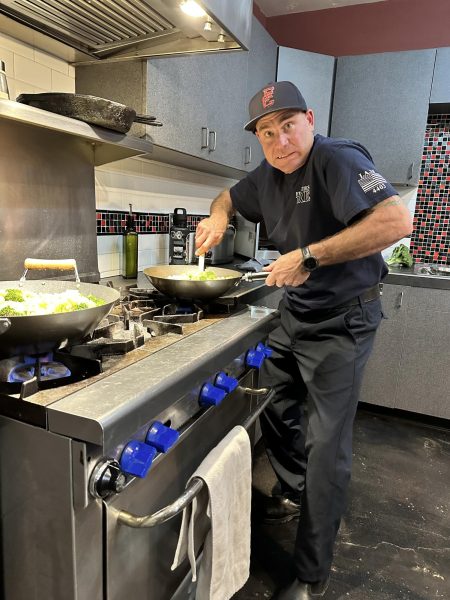
“If you add butter and garlic to anything, people will think it’s delicious,” said Vreeland. “Watch, [the crew] will start to smell the
garlic and come drifting in.”
He was right; within 15 minutes of grating parmesan cheese and sautéing the garlic and vegetables, most of the shift’s crew was in the
day room cocking their heads to see what they would be treated with.
“I cook dinner for everyone about once a month,” said Vreeland. “I like to take care of [the crew] when I have the time to.”
I helped Vreeland dish-up servings to the crew members– even Battalion Chief Angello. One by one, each person filed to the table and found a seat with visible excitement to share a home-cooked meal.
When I sat at the table with the firefighters that day: I was no longer just a reporter, no longer just a Ride-Along, and no longer felt like I had to prove to the crew– or myself– that I belonged at the station. FCFA Station 1’s men did what they do best; they created a kind, humble, and confident environment where anybody is safe and welcome.
The kitchen table is sacred– it only took one meal shared around it to prove that.